Wealth Accumulation and Asset Protection: Leveraging Holding Companies for Successful Owner-Managers
I. Introduction: The Power of the OpCo/HoldCo Structure
For successful Canadian owner-managers, the primary focus during the early stages of business is often simply driving revenue and managing day-to-day operations. However, as the operating company (OpCo) grows and accumulates excess cash, the corporate structure must evolve to protect built-up wealth and optimize tax efficiency.
A sophisticated and highly recommended strategy is the implementation of a holding company (HoldCo). By establishing a HoldCo, business owners can isolate risk from accumulated passive assets, defer taxes on investment income, and unlock powerful strategies for future succession planning or business sale.
II. Creditor Protection and Risk Mitigation: Separating Active and Passive Assets
Operating a business inherently involves risks, ranging from trade liabilities and potential lawsuits to unforeseen economic downturns. If a corporation holds its active business assets (like inventory and receivables) and its passive assets (like excess cash and real estate) together, all of it is vulnerable to potential creditors.
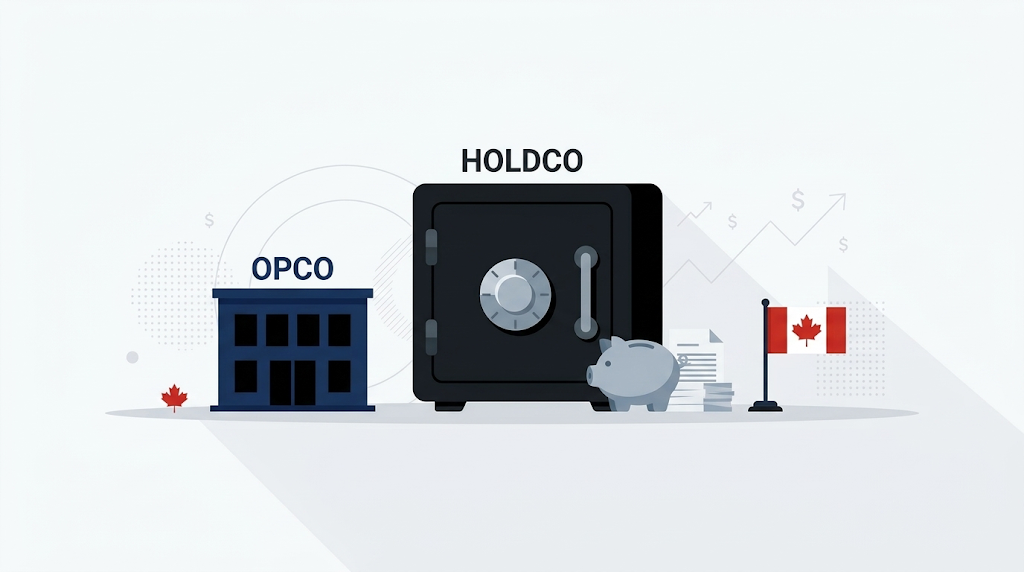
By inserting a HoldCo above the OpCo, the business owner can periodically extract excess retained earnings from the OpCo and move them up to the HoldCo. This effectively "sweeps" the safe, passive capital away from the operational liabilities of the OpCo. If the OpCo faces a lawsuit or bankruptcy, the accumulated wealth sitting safely in the HoldCo is generally shielded from the OpCo’s creditors.
III. Tax-Free Intercompany Dividends and Corporate Wealth Accumulation
If an individual were to withdraw excess cash from their OpCo directly as personal dividends to invest, they would trigger immediate personal income tax. With a HoldCo in place, the OpCo can pay tax-free intercompany dividends up to the HoldCo.
This mechanism allows the business owner to accumulate and reinvest corporate profits with gross pre-tax dollars (net of corporate tax), creating a much larger pool of capital to compound over time. The HoldCo becomes the centralized investment vehicle, housing portfolios of stocks, real estate, or other ventures without the administrative complexity of paying out personal taxes until the funds are actually needed for personal living expenses.
IV. Executing a Section 85 Rollover: Navigating ACB, FMV, and Elected Amounts
Many entrepreneurs begin as sole proprietorships or fail to set up a HoldCo on Day 1 of incorporation. Fortunately, this can be corrected later. To move shares or assets from an existing corporation to a newly formed HoldCo without triggering immediate capital gains tax, tax professionals utilize a Section 85 Rollover.
The Rollover allows the shareholder to transfer assets at an "Elected Amount"—the tax value—which is often lower than the Fair Market Value (FMV). This elected amount becomes the Adjusted Cost Base (ACB) of the new shares received from the HoldCo. By carefully calculating the ACB and Elected Amount, the transfer can be completed on a tax-deferred basis, ensuring no taxes are payable until the shares of the HoldCo are eventually disposed of. Eligible investments and specific assets like cash, accounts receivable, and inventory must be assessed on an individual basis to determine eligibility for the rollover.
V. Consideration Received: Promissory Notes, Contributed Surplus, and Legal Stated Capital
In a reorganization involving a Section 85 Rollover, the HoldCo must issue consideration to the shareholder in exchange for the transferred assets. This usually takes the form of shares, but can also include cash or a promissory note.
- Promissory Notes: The HoldCo can issue a demand promissory note to the shareholder for the excess value. This is highly advantageous, as the shareholder can be repaid the principal of the promissory note tax-free over time.
- Contributed Surplus / Stated Capital: Any excess value over the legal stated capital not covered by the promissory note or shares can be booked as contributed surplus in the equity section of the HoldCo. However, withdrawing funds from contributed surplus can trigger dividend income tax, unlike the tax-free repayment of a promissory note.
VI. Asset Purification and Maximizing the Lifetime Capital Gain Exemption (LCGE)
If the business owner intends to sell the shares of the OpCo in the future, they want to ensure those shares qualify as Qualified Small Business Corporation (QSBC) shares to utilize the Lifetime Capital Gain Exemption, which shields a significant portion of capital gains from tax.
To qualify, the OpCo must meet strict "asset purification" tests, meaning at least 90% of the fair market value of the assets must be used in active business activities at the time of sale. By sweeping out excess cash, passive investments, or non-active assets into the HoldCo prior to a potential sale via the aforementioned mechanisms, the OpCo becomes "purified." This proactive structuring ensures the full value of the business sale can be shielded under the LCGE.
VII. Frequently Asked Questions
Q1: What is the main benefit of an OpCo/HoldCo structure for an established business? A1: The main benefit is creditor proofing (separating operational risks from passive wealth) and the ability to compound investment returns using tax-free intercompany dividends.
Q2: Can I transfer shares and cash from my operating company to a holding company tax-free? A2: Yes, by utilizing a Section 85 Rollover, you can transfer assets and shares to a newly formed HoldCo on a tax-deferred basis without immediate capital gains triggers.
Q3: What is a Section 85 Rollover? A3: It is an income tax provision that allows a taxpayer to transfer property (like shares or capital assets) to a corporation in exchange for consideration, electing a tax value that defers any immediate realization of capital gains.
Q4: How do promissory notes help in taking funds out of a Holding Company? A4: Funds paid to a shareholder via a promissory note during a corporate reorganization can be repaid tax-free to the shareholder, as it is simple repayment of corporate debt.
Q5: What does asset purification mean for the Lifetime Capital Gain Exemption (LCGE)? A5: Asset purification means removing passive assets and excess cash from the operating company so that it meets the CRA's 90% active business asset test required to claim the LCGE upon the future sale of the business.
Q6: What happens to my contributed surplus if I withdraw it from the company? A6: Unlike a promissory note repayment, money drawn from the contributed surplus is treated as a taxable dividend to the shareholder.
Q7: Is it too late to set up a holding company if I have already been successfully operating for years? A7: No. Even successful, mature corporations can be reorganized using complex tax strategies and legal steps to implement a HoldCo and shift assets securely.
Q8: Why does the CRA require strict rules for intercompany dividends? A8: The rules ensure that dividends are paid within qualifying corporate groups, preventing the leakage of corporate tax revenues while allowing for legitimate business wealth compounding.
Disclaimer: This article is for informational purposes only and does not constitute legal or tax advice. Corporate structuring and trust law are highly complex and subject to strict CRA regulations. Always consult with a qualified tax accountant and corporate lawyer before implementing these strategies.