The Canadian E-Commerce Accounting Guide: Managing Finances for Amazon & Shopify Sellers
I. Introduction: Mastering E-Commerce Financials in Canada
Building a successful e-commerce brand on Amazon or Shopify requires incredible focus on marketing, procurement, and logistics. Yet, without robust financial management, high sales volumes can easily mask cash flow problems and unforeseen tax liabilities.
For Canadian e-commerce sellers, navigating compliance with the Canada Revenue Agency and understanding international tax obligations are vital to sustaining profitability. This guide outlines the essential financial practices necessary to keep your books pristine, streamline your operations, and ensure you remain ahead of year-end deadlines.
II. Setting Up Your Accounting Architecture: QuickBooks Online and the General Ledger
At the heart of every successful e-commerce business is a reliable general ledger. Utilizing professional bookkeeping software like QuickBooks Online provides the foundation needed for accurate financial tracking.
For e-commerce sellers, a customized chart of accounts is paramount. Unlike standard businesses, an e-commerce seller must track inventory assets, Cost of Goods Sold, platform fees, advertising spend, and merchant processing fees separately. A well-configured QuickBooks Online setup ensures that your financial statements reflect true profitability, allowing you to track Key Performance Indicators (KPIs) effectively rather than just aggregating total sales.
III. Reconciling Multiple Payment Processors and High-Volume Transactions
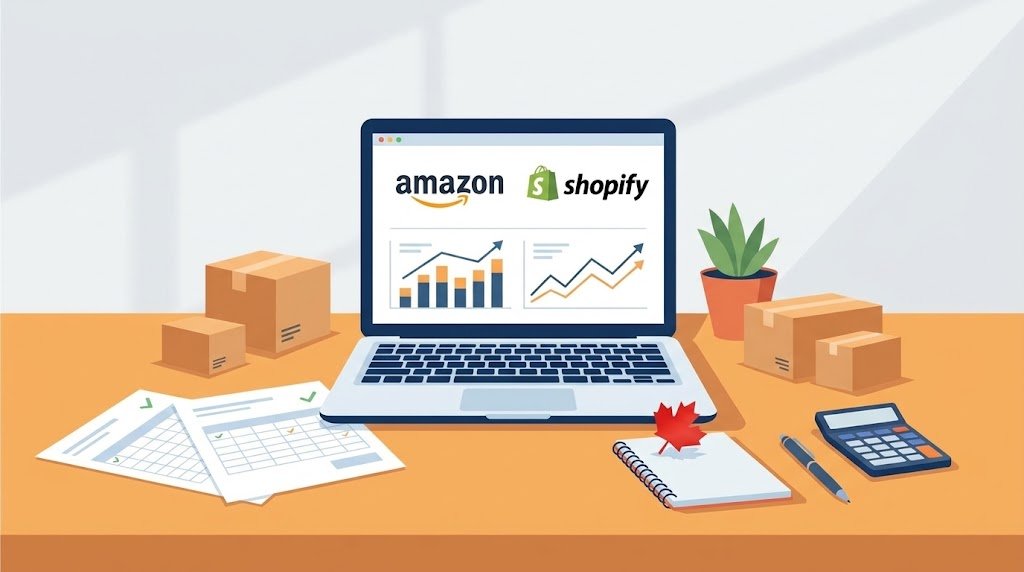
One of the most complex aspects of e-commerce bookkeeping is reconciling payouts from various platforms. Shopify Payments, Stripe, PayPal, and Amazon Seller Central all deposit varied net amounts after deducting fees, refunds, and chargebacks.
To prepare clean books, you must record the gross sales, the processing fees, and refunds at the transaction level. Relying only on bank deposits leads to inaccurate revenue figures and incorrect sales tax reporting. Automated integrations that sync transaction data directly into QuickBooks are highly recommended to save on accounting fees and minimize human data entry errors.
IV. Sales Tax Navigation: GST/HST, ITCs, and Provincial Registrations
In Canada, e-commerce sellers generally need to register for a GST/HST account if their worldwide taxable revenues exceed $30,000 over four consecutive calendar quarters.
As a registrant, you are obligated to collect and remit the correct Goods and Services Tax / Harmonized Sales Tax based on the destination province of your customer. Furthermore, being registered unlocks the ability to claim Input Tax Credits (ITCs) on business expenses. This includes the GST paid on imported inventory, customs duties, software subscriptions, and advertising.
Additionally, you must evaluate compliance with non-harmonized provincial sales taxes in British Columbia, Saskatchewan, Manitoba, and Quebec. Depending on sales volume and inventory placement, registering directly with these provincial authorities may be required.
V. Cross-Border Complexities: U.S. Tax Treaty Obligations for Canadian Sellers
Many Canadian Amazon and Shopify sellers also expand into the United States. Even without physical presence, operating in the U.S. marketplace triggers income tax filing requirements to the IRS.
Canadian corporations selling into the U.S. may be required to file Form 1120-F (U.S. Income Tax Return of a Foreign Corporation) along with Form 8833 (Treaty-Based Return Position Disclosure). These returns are necessary to formally claim the exemption from U.S. corporate tax under the U.S.-Canada Tax Treaty. Failing to file these information returns can lead to substantial penalties, making specialized cross-border tax guidance essential.
VI. Frequently Asked Questions
Q1: Why do I need specialized bookkeeping software for my e-commerce business? A1: Software like QuickBooks Online creates a proper general ledger, tracking inventory, cost of goods sold, and complex platform fees specific to e-commerce.
Q2: What is the $30,000 threshold for GST/HST registration? A2: Once your worldwide taxable sales reach $30,000 within four consecutive quarters, you are legally required to register for, collect, and remit Canadian GST/HST.
Q3: Can I claim back the duty and GST paid on imported inventory? A3: Yes. As a GST/HST registrant, you can claim Input Tax Credits (ITCs) to recover the GST/HST paid at the border, effectively saving on import costs.
Q4: Who is responsible for collecting sales taxes, Amazon or me? A4: "Marketplace Facilitator" rules require Amazon and Shopify to collect GST/HST on your sales; however, you still report your total sales, and your registration remains necessary for claiming ITCs.
Q5: What are the provincial sales tax requirements aside from GST/HST? A5: You may need to separately register in British Columbia, Manitoba, Quebec, and Saskatchewan if your sales reach specific economic nexus thresholds in those provinces.
Q6: What forms are required for filing U.S. tax returns for a Canadian corporation? A6: You typically need to file Form 1120-F and Form 8833 to claim tax treaty benefits and avoid severe IRS penalties for non-compliance.
Q7: Do I really need to reconcile daily payment processor transactions? A7: Yes. Failing to reconcile the gross sales against processing fees and refunds means your revenue and expense records will be highly understated.
Q8: Why does clean bookkeeping save me accounting fees at year-end? A8: Clean books with fully reconciled bank and platform accounts allow your CPA to immediately prepare your corporate taxes without having to perform extensive retroactive cleanup.
Disclaimer: This article is for informational purposes only and does not constitute legal or tax advice. Corporate structuring and trust law are highly complex and subject to strict CRA regulations. Always consult with a qualified tax accountant and corporate lawyer before implementing these strategies.