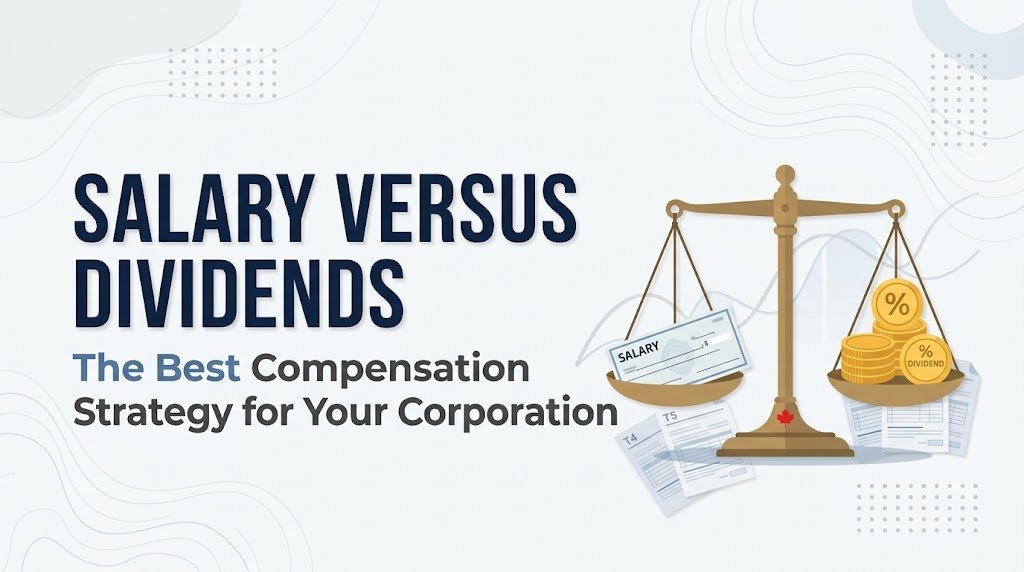
Salary Versus Dividends: The Best Compensation Strategy for Your Corporation
I. Introduction: The Power of Choice for Owner-Managers
When you incorporate your business in Canada, you gain a powerful tax planning advantage: you are no longer just an employee, you are an owner-manager. This means you have the flexibility to choose exactly how you withdraw money from your corporation.
The two primary methods—salary and dividends—have vastly different tax implications, administrative requirements, and long-term benefits. Choosing the right compensation strategy is one of the most impactful year-end decisions you will make for both your corporate growth and personal wealth.
II. Paying Yourself a Salary: Building Your Retirement and RRSP
A salary is considered employment income. From a corporate perspective, the salary you pay yourself is a deductible business expense, which directly reduces your corporation’s net taxable income.
To implement this, you must set up a payroll account with the Canada Revenue Agency (CRA), make required monthly source deductions, and issue a T4 slip at the end of the year.
Key benefits of a salary include:
- Creating RRSP Contribution Room: Only earned income counts toward RRSP limits. A salary generates new RRSP contribution room for the following year.
- Building CPP Entitlement: A salary requires Canada Pension Plan contributions, which builds your guaranteed retirement pension.
- Consistent T4 Income: Traditional lenders often prefer looking at a T4 slip when you apply for a mortgage or other personal financing.
III. Paying Yourself Dividends: Cash Flow and Simplicity
A dividend is a distribution of after-tax corporate profit to you as a shareholder. Because the corporation has already paid tax on this money, the Canadian tax system applies a “dividend tax credit” to prevent double taxation.
Paying dividends is administratively much simpler than paying a salary. You do not need to set up a payroll account or remit monthly deductions to the CRA. Instead, the corporation issues a T5 slip at the end of the year.
Key benefits of dividends include:
- No CPP Obligations: Dividends are not pensionable earnings, so you can avoid making mandatory CPP contributions.
- Administrative Simplicity: You save time and accounting fees by avoiding the ongoing hassle of monthly payroll remittances.
- Immediate Cash Flow: Dividends can be declared and paid out at any time based on the immediate cash position of the business.
IV. The Hybrid Approach: Finding Your Optimal Mix
For most Canadian owner-managers, the universal answer is not choosing exclusively between salary or dividends—it is finding the right strategic mix of both.
A common and highly effective strategy is to pay yourself a base salary up to the maximum CPP threshold or to a level that maximizes your desired RRSP contribution room. You then take any additional funds needed for personal living expenses as dividends. This approach balances your long-term retirement planning goals with short-term cash flow needs and minimizes overall tax liabilities.
V. Frequently Asked Questions & Our Services
Which option creates the lowest overall tax burden? Through integration, the combined corporate and personal tax paid on a salary and that paid on a dividend should be roughly similar. The best choice depends on your personal marginal tax bracket, corporate income level, and retirement goals.
Do I need a CPA to help decide my compensation split? Yes. A CPA can run side-by-side tax models using your actual corporate and personal numbers to identify the exact dollar split that leaves the most money in your pocket.
VI. Frequently Asked Questions
Is it better to take a salary or dividends to save on taxes? Through a tax concept called “integration,” the CRA tries to ensure you pay roughly the same amount of combined tax (corporate + personal) whether you choose a salary or dividends. However, because personal tax brackets and corporate tax rates differ, there is almost always a slight advantage one way or the other depending on your specific income level and province. A custom tax plan is required to find your exact “sweet spot.”
Can I pay myself entirely in dividends and avoid paying CPP? Yes. Since dividends are considered investment income rather than employment income, they are not subject to Canada Pension Plan (CPP) contributions. Choosing dividends allows you to bypass the mandatory employer and employee CPP contributions, saving you thousands of dollars annually. However, you should only do this if you are actively investing for your own retirement through other vehicles, as you will not be building up a government pension.
If I choose to pay myself a salary, do I need to set up a payroll account? Yes, absolutely. If you pay yourself a salary, the CRA views you as an employee of your own corporation. This means you must register for a payroll program account, calculate and deduct income tax and CPP from each pay, and remit those deductions to the CRA monthly. At year-end, you will also need to prepare and file a T4 slip and T4 Summary.
Can I mix both salary and dividends throughout the year? Yes, and for many business owners, this is the ideal “hybrid” approach. Many owner-managers pay themselves a steady base salary to cover their everyday living expenses and to create RRSP contribution room. Then, if the business performs exceptionally well or they need extra funds for a specific personal expense, they will declare a one-time dividend.
Do dividends help me build RRSP contribution room? No. This is one of the biggest downsides to taking only dividends. The CRA only calculates your Registered Retirement Savings Plan (RRSP) contribution room based on “earned income.” While a T4 salary counts as earned income, T5 dividends are considered investment income and do not generate any new RRSP contribution room.
If my business is new, should I wait to pay myself? Many new business owners choose to leave their money inside the corporation during the early stages to reinvest in growth, which can be highly tax-efficient since active business income inside a corporation is taxed at a much lower rate (typically around 9% to 12.2% depending on the province) than personal income. You should only withdraw what you need for personal living expenses, and we can help you choose the most tax-advantageous way to do so when the time comes.
How can I get help with my year-end tax planning? We offer comprehensive year-end tax planning sessions for Canadian corporations. We will analyze your revenue, review your RRSP and CPP goals, and prepare the necessary T4 or T5 filings to ensure you remain fully compliant while maximizing your wealth.
Disclaimer: This article is for informational purposes only and does not constitute legal or tax advice. Corporate structuring and trust law are highly complex and subject to strict CRA regulations. Always consult with a qualified tax accountant and corporate lawyer before implementing these strategies.