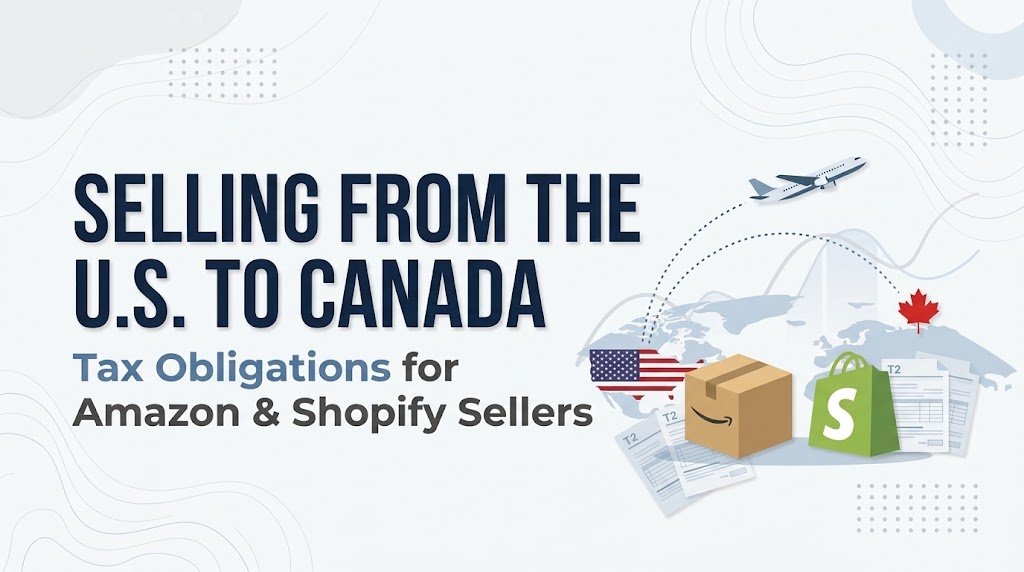
Selling from the U.S. to Canada: Tax Obligations for Amazon & Shopify Sellers
I. Introduction: Expanding Your E-commerce Brand North
Canada is one of the most lucrative expansion markets for U.S.-based Amazon and Shopify sellers. With a highly engaged online consumer base and close geographic proximity, crossing the northern border is a natural growth step. However, navigating the Canadian tax landscape—which operates with both federal and provincial layers—can be complex for foreign corporations.
Unlike the U.S. system, Canada relies on a federal Value-Added Tax (VAT) system alongside provincial taxes, as well as strict non-resident corporate income tax filing requirements. This guide breaks down exactly what U.S. e-commerce sellers need to know to stay compliant with the Canada Revenue Agency (CRA) while maximizing their profitability.
II. Canadian Sales Tax Obligations for U.S. Sellers
Understanding when you need to register for, collect, and remit Canadian sales tax (GST/HST) is your first major hurdle. The CRA requires U.S. sellers to register for a GST/HST account if they meet all three of the following criteria:
- You carry on business in Canada: The threshold for this is relatively low. If you hold inventory in a Canadian Amazon FBA fulfillment center, use a Canadian 3PL, or heavily target Canadian customers through localized advertising, the CRA considers you to be carrying on business in Canada.
- You sell taxable supplies: Almost all physical goods sold on Amazon and Shopify are considered taxable supplies under Canadian law.
- You are not a “small business supplier”: A small business supplier is defined as an entity whose worldwide taxable sales of goods and services drop below $30,000 CAD over four consecutive calendar quarters. If your Canadian sales exceed $30,000 CAD, registration becomes mandatory.
Once registered, you will be assigned a Business Number (BN) and must file sales tax returns on an annual, quarterly, or monthly basis, depending on your sales volume.
III. E-commerce Platform Updates: Amazon & Shopify Responsibilities
Recent legislative changes in Canada have introduced “Marketplace Facilitator” rules, shifting certain tax collection responsibilities directly to platforms like Amazon and Shopify.
- Unregistered Sellers: If you are not registered for GST/HST, the platforms are now legally required to calculate, collect, and remit federal sales taxes on your behalf for orders shipped to Canadian customers.
- Registered Sellers: If you are registered for GST/HST (which is mandatory if you exceed the $30,000 threshold and hold inventory in Canada), the dynamics change. You are responsible for managing your tax settings within Seller Central or Shopify to ensure the correct taxes are charged, and you must report these figures on your own GST/HST returns.
Even with platforms handling some of the collection, maintaining your own GST/HST registration is highly beneficial due to the ability to claim ITCs.
IV. Input Tax Credits (ITCs): Recovering Customs and Duties
One of the biggest advantages of registering for a GST/HST account is the ability to claim Input Tax Credits (ITCs).
When you import goods into Canada to stock your Shopify 3PL or Amazon FBA warehouse, you are charged GST on the value of those goods at the border by the Canada Border Services Agency (CBSA). You may also pay GST/HST on Canadian advertising, local shipping, prep center fees, and other business expenses.
By being a GST/HST registrant, you can claim these taxes back as ITCs on your sales tax return. This effectively zeroes out the tax cost of importing and operating in Canada, allowing you to recover capital that would otherwise eat into your margins.
V. Understanding Provincial Sales Taxes (PST, RST, QST)
In addition to the federal Goods and Services Tax (GST) at 5%, several provinces apply their own sales taxes. Depending on where your customer is located, you will encounter different rates:
- HST (Harmonized Sales Tax): Provinces like Ontario (13%), Nova Scotia (15%), New Brunswick (15%), Newfoundland (15%), and PEI (15%) combine the federal and provincial taxes into a single HST rate. You manage this through your standard federal CRA account.
- GST Only: Alberta, Nunavut, Yukon, and the Northwest Territories only charge the 5% federal GST.
- Provincial Taxes (PST/RST/QST): British Columbia (7% PST), Saskatchewan (6% PST), Manitoba (7% RST), and Quebec (9.975% QST) require separate provincial tax management. If you hold inventory in these specific provinces or meet their individual economic nexus thresholds, you may be required to register directly with their provincial tax authorities to collect and remit these localized taxes.
VI. Federal Income Tax: T2NR and Tax Treaty Applicability
Beyond sales tax, U.S. corporations selling into Canada have corporate income tax reporting obligations. As a non-resident corporation carrying on business in Canada, you are required to file a federal T2 Corporate Income Tax Return, specifically the T2NR (Non-Resident).
The U.S.-Canada Tax Treaty: Fortunately, the U.S.-Canada Tax Treaty protects most U.S. e-commerce sellers from actually paying Canadian corporate income tax, provided you do not have a “Permanent Establishment” (PE) in Canada. Utilizing an Amazon FBA warehouse or a third-party logistics center typically does not constitute a PE.
However, you must still file the T2NR to claim this treaty exemption. A complete filing includes:
- Schedule 91 (Information Concerning Claims for Treaty-Based Exemptions): This is the critical form where you formally claim your exemption from Canadian income tax under the U.S.-Canada Tax Treaty.
- Schedule 97 (Additional Information on Non-Resident Corporations in Canada): Details your business structure and Canadian activities.
- Schedule 19 (Non-Resident Shareholder Information): Reports ownership details for the foreign corporation.
Failing to file the T2NR and Schedule 91 can result in heavy CRA penalties, even if no tax is ultimately owed.
VII. Frequently Asked Questions & Our Services
Do I have to register for GST if Amazon is already collecting it? Yes, if your Canadian sales exceed $30,000 CAD and you hold inventory in Canada, you are legally obligated to register. Furthermore, registering is the only way to recover the GST paid on your import duties and local expenses via ITCs.
Does the U.S.-Canada tax treaty exempt me from sales tax? No. The tax treaty only applies to corporate income taxes. It does not provide any relief or exemption from collecting and remitting GST/HST or provincial sales taxes.
How can I get help with this process? Navigating cross-border compliance requires specialized knowledge. We offer comprehensive, end-to-end Canadian tax services specifically designed for U.S. Amazon and Shopify sellers.
Our services include:
- Analyzing your Amazon and Shopify sales reports for nexus thresholds.
- Filing the application for your Canadian Business Number and GST/HST account.
- Preparation and filing of your GST/HST returns (including claiming ITCs).
- Preparation and filing of your T2NR Corporate Income Tax Return and all respective tax treaty schedules (S91, S97, S19).
Pricing for our full cross-border compliance service starts from $1,000. Please reach out to schedule a consultation and ensure your Canadian expansion is secure, compliant, and profitable.
Disclaimer: This article is for informational purposes only and does not constitute legal or tax advice. Corporate structuring and trust law are highly complex and subject to strict CRA regulations. Always consult with a qualified tax accountant and corporate lawyer before implementing these strategies.